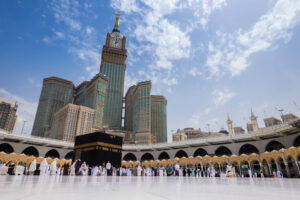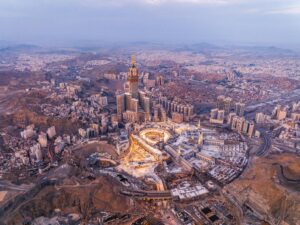
The Holy Kaaba stands as the most sacred site on Earth, revered by Muslims across every corner of the world. It is the first house ever built for the worship of Allah (SWT) alone, the qibla towards which Muslims turn their hearts and bodies in the five daily prayers. No prayer is accepted without facing it, and it remains the destination of pilgrims and visitors who come from every land.
Located at the very center of Al-Masjid Al-Haram in Makkah, this majestic structure was built by Prophet Ibrahim (AS) and his son Ismail under the command of Allah (SWT), as a symbol of pure monotheism.
The Kaaba was constructed using solid stones from the mountains of Makkah. It stands approximately fifteen meters high and has four corners pointing to the four directions of the Earth, each with its own name and deep historical meaning: the Yemeni Corner (Rukn Al-Yamani), the Levantine Corner (Rukn Al-Shami), the Iraqi Corner (Rukn Al-Iraqi), and the Black Stone Corner (Rukn Al-Aswad), from which the circumambulation (tawaf) begins and ends.
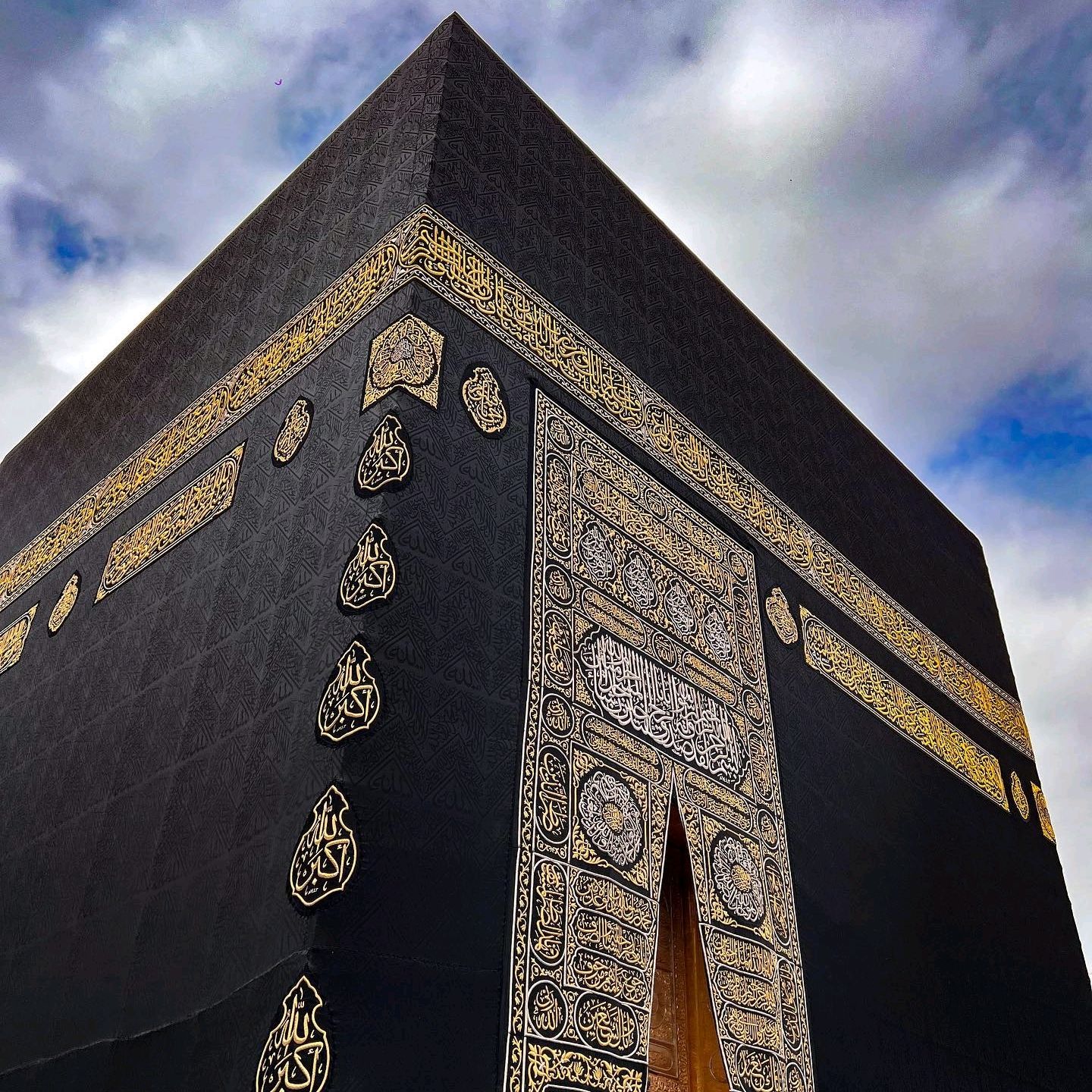
Every part of the Kaaba carries profound spiritual and historical symbolism: the Black Stone stands as a witness to the divine covenant; Al-Multazam is a place of heartfelt supplication; and Hijr Ismail embraces the legacy of prophecy and mercy. The Kaaba is adorned with black silk embroidered in gold thread, a magnificent sight that embodies its majesty and sanctity through the ages.
To deepen one’s appreciation and reverence for this sacred structure, we explore below its key features and their meanings.
The Black Stone (Al-Hajar Al-Aswad)
Embedded in the eastern corner of the Kaaba, Al-Hajar Al-Aswad is the starting and ending point of tawaf. It is revered as a symbol of the believers’ covenant with Allah (SWT). Pilgrims strive to touch or gesture toward it as an act of devotion and renewal of faith.
The Door of the Kaaba
Located on the eastern side, the Kaaba’s door serves as its main entrance. The current door, made of pure gold, was commissioned by King Khalid bin Abdulaziz (may Allah have mercy on him) and weighs hundreds of kilograms. It is among the most striking and revered elements of the Kaaba’s exterior beauty.
Mizab Al-Rahmah
Atop the northern wall of the Kaaba lies a golden spout known as Mizab Al-Rahmah, or “The Spout of Mercy,” which drains rainwater from the roof. Standing beneath it during rainfall is considered a blessed moment, symbolizing divine mercy pouring down upon the sacred ground.
Al-Shadharwan
This marble base encircles the lower part of the Kaaba’s walls, except on the side of Hijr Ismail. It strengthens the structure, protects its foundation from floods, and helps secure the Kaaba’s covering (Kiswa). The term “Shadharwan” refers to a protective skirt or support.
Hijr Ismail
Situated on the northern side of the Kaaba in a semi-circular shape, Hijr Ismail, also known as Al-Hatim, is considered part of the original Kaaba. Tawaf must be performed around it, not through it. It is said that Hajar and her son Prophet Ismail (AS) used to rest there, and that Prophet Ibrahim (AS) made it a shelter for them. This area carries the memory of devotion, sacrifice, and divine mercy.
Al-Multazam
Al-Multazam is the space between the Black Stone and the Kaaba’s door. Pilgrims are encouraged to cling to it and pray sincerely, as it is a place where supplications are believed to be answered. It represents a moment of nearness, humility, and surrender to Allah (SWT).
Maqam Ibrahim
Maqam Ibrahim is the stone on which Prophet Ibrahim (AS) stood while raising the foundations of the Kaaba. The imprint of his blessed feet remains visible to this day. Allah (SWT) commanded believers to take it as a place of prayer. After completing the seven rounds of tawaf, Muslims perform two units of prayer behind this sacred spot.
The Four Corners of the Kaaba
The Kaaba’s four corners each hold geographical and spiritual significance:
- The Eastern Corner: houses the Black Stone.
- The Iraqi Corner: faces northeast.
- The Levantine Corner: faces northwest.
- The Yemeni Corner: faces southwest and is recommended to be touched during tawaf due to its special virtue.
The Kiswa
The Kiswa is the Kaaba’s iconic black silk covering, richly embroidered with gold and silver Quranic verses. It is replaced every year on the Day of Arafah. Produced in Makkah’s Kiswa Factory, it is made from the finest natural silk and symbolizes the reverence and grandeur of this holy structure, encircling it like a radiant frame of light.
Inside the Kaaba
The interior of the Kaaba contains large wooden pillars that support its roof and a staircase leading to the upper level. Its walls are lined with finely decorated white marble. Inside, there is a special area known as Maqam Al-Tawbah (“The Place of Repentance”), where select visitors and dignitaries sometimes pray.
Conclusion
Visiting the Holy Kaaba is far more than a journey to a sacred building, it is a journey into the depths of faith, a renewal of one’s covenant with Allah (SWT), and a moment of spiritual tranquility. Hearts are filled with peace, and souls are united in devotion to the One God, facing one qibla and sharing one purpose.
With over four decades of experience in serving pilgrims from across the globe, we continue our mission to embody the essence of spiritual hospitality, offering thoughtfully designed packages that cater to the diverse needs of pilgrims and Umrah visitors. With us, every journey to the Holy Kaaba becomes a story to tell and a memory engraved in the heart.